
Convert 10000 steps to miles, kilometres, calories, and time, personalised by your height and pace.
The 10,000-step goal is the most popular daily fitness target in the world, printed on trackers, watches, and phone screens everywhere. But almost nobody who chases it knows how far it actually is. If you have hit your 10,000 steps today and wondered what that means in real distance, the answer for most adults is that 10000 steps to miles works out to roughly 4.55 miles.
That said, the honest answer is that it depends on you, and this page is built to give you the precise figure for your body rather than a vague range. Below you will find your exact distance by height, the equivalent in kilometres, the calories you burned, how long it takes, and what the science really says about whether you need 10,000 steps at all. Enter your details in the calculator and read on for the full picture.
| Steps | Miles | Km |
|---|
10,000 steps is about 4.55 miles (7.32 km) for an average adult walking at a moderate pace. Women average around 4.30 miles and men around 4.73 miles, because stride length depends on height. At a moderate pace, 10,000 steps takes 1 hour 20 minutes to 1 hour 40 minutes and burns roughly 372 calories.
For an average adult walking at a moderate pace, 10,000 steps is about 4.55 miles, or 7.32 kilometres. Women of average height cover closer to 4.30 miles and men closer to 4.73 miles, because stride length is driven by height. At a moderate pace the walk takes somewhere between one hour twenty minutes and one hour forty minutes, and burns roughly 372 calories for a person of average weight. Those are the headline numbers behind every 10000 steps to miles conversion, but each one shifts with your own body, which is exactly why a single figure never tells the whole story.
The four-to-five-mile range exists because stride length varies enormously between people, and stride length is what turns steps into distance. Stride length is roughly forty-one to forty-five percent of your height, so a taller person covers more ground with every step and needs fewer steps to reach a mile. A shorter person takes more steps per mile, so their 10,000 steps add up to less total distance. Across the normal range of adult heights, that difference works out to almost a full mile between the shortest and tallest adults walking the identical 10,000 steps. Rather than settle for a vague band, entering your height lets the calculator work out exactly where you land inside it.
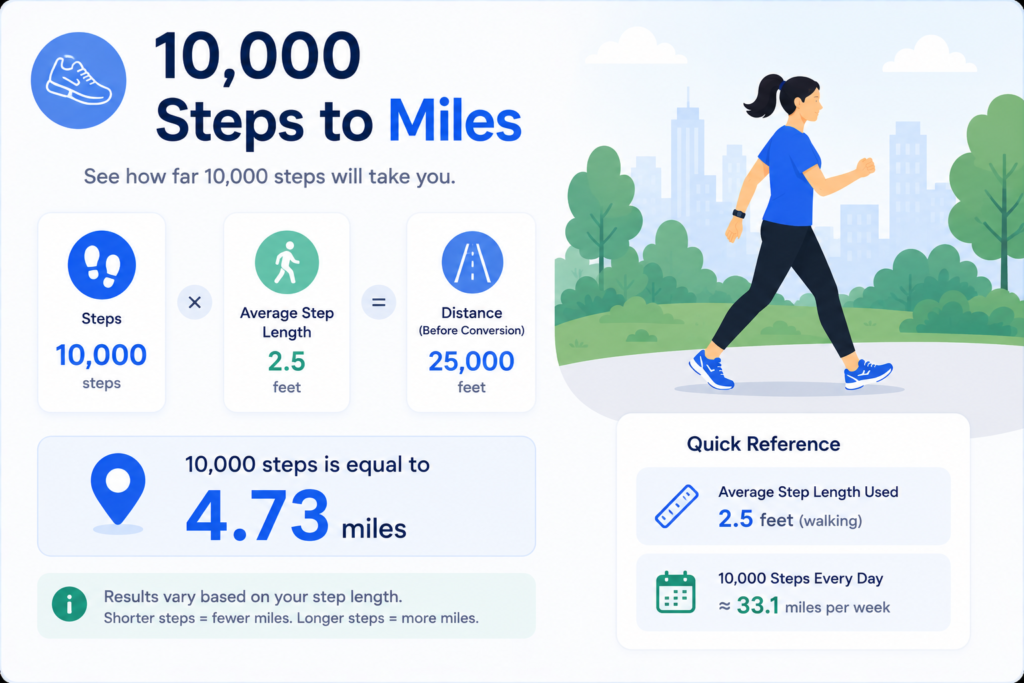
How to convert 10000 steps to miles yourself is straightforward once you know the formula. Multiply your number of steps by your stride length in feet, then divide the result by 5,280, which is the number of feet in a mile. For an average walking stride of 2.4 feet, the maths runs 10,000 multiplied by 2.4, divided by 5,280, which gives 4.55 miles. If you would rather not do the arithmetic, the calculator above handles it instantly, and it becomes far more accurate the moment you tell it your height, because it can then estimate your personal stride instead of using the average. To convert the figure for your own body, that single input makes all the difference.
Using the calculator is simple. It comes pre-set to 10,000 steps, so you do not have to type the number in. Add your height and choose your pace, and the tool immediately updates your distance in both miles and kilometres, along with the calories you burned and the time the walk took. Because it uses your height to estimate stride length, the figure it returns is tailored to you rather than to a statistical average, which is what separates a genuinely useful result from a rough guess.
Ten thousand steps in miles by height is where the real precision comes in, because height has the single biggest effect on your distance. The chart runs across a full range of adult heights so you can find yours and read off the answer directly. A person who is five feet tall covers about 3.98 miles in 10,000 steps, someone five foot six covers about 4.55 miles, and a six foot two adult covers about 5.24 miles. That spread of well over a mile from the shortest to the tallest is not a rounding error; it is the whole reason a personalised figure beats a generic one. The same chart also shows the equivalent in kilometres, since many people track their walking in metric.
| HEIGHT | MILES | KM |
|---|---|---|
| 5‘0" (152 cm) | 3.98 | 6.41 |
| 5‘4" (163 cm) | 4.30 | 6.92 |
| 5‘6" (168 cm) | 4.55 | 7.32 |
| 5‘9" (175 cm) | 4.73 | 7.62 |
| 6‘2" (188 cm) | 5.24 | 8.43 |
Step ranges also matter, because plenty of people search for the distances just below 10,000 as they build up to the goal. Seven thousand steps is about 3.18 miles, eight thousand steps is about 3.64 miles, and nine thousand steps is about 4.09 miles, before ten thousand steps reaches roughly 4.55 miles. Seeing the progression laid out makes the 10000 steps to miles jump easy to understand, showing what each extra thousand steps adds to your day, which is useful whether you are pushing toward the full target or simply curious how far you have already come by mid-afternoon.
| STEPS | MILES | KM |
|---|---|---|
| 7,000 | 3.18 | 5.12 |
| 8,000 | 3.64 | 5.86 |
| 9,000 | 4.09 | 6.59 |
| 10,000 | 4.55 | 7.32 |
For a woman of average height (5’4″), 10,000 steps is about 4.30 miles or 6.92 km. A shorter woman around 5’2″ covers about 4.15 miles, while a taller woman approaches 4.5 miles. Women average slightly less than men because of a typically shorter stride. Check our Steps to Miles Calculator.
Ten thousand steps to miles for a woman is one of the most common versions of this question, and it deserves a precise answer. For a woman of average height, which is about five foot four, 10,000 steps is approximately 4.30 miles or 6.92 kilometres. A shorter woman of around five foot two covers closer to 4.15 miles, while a taller woman approaching five foot seven covers nearer 4.5 miles.
The reason the figure for women sits slightly below the figure for men comes down to average height, not gender itself. Because women are on average a little shorter than men, their average stride is a little shorter too, so the same 10,000 steps cover marginally less ground. The important nuance is that a tall woman and a tall man of exactly the same height will cover almost identical distance, because it is body proportion, not sex, that sets stride length. As always, entering your own height gives you a figure far more accurate than any average based on gender.
Walking 10,000 steps covers about 4.55 miles and burns roughly 372 calories for an average adult. Since one pound of fat is about 3,500 calories, a daily 10,000-step habit can burn close to a pound every 9 to 10 days through activity alone, alongside diet. Check our Steps to Miles Calculator.
Ten thousand steps to miles for weight loss is another major reason people look up this conversion, and here the calorie side of the equation matters as much as the distance. Walking 10,000 steps covers about 4.55 miles and burns roughly 372 calories for a person of average weight, though a heavier person burns considerably more, closer to 480 calories, and a brisker pace pushes the number higher still.
Because one pound of body fat represents roughly 3,500 calories, a consistent daily 10,000-step habit contributes meaningfully to the calorie deficit that drives weight loss, working out to around a pound every week and a half from walking alone. That figure explains why walking is such a sustainable foundation for weight management, and also why it works best alongside mindful eating rather than on its own. If you want the calorie number matched to your own weight rather than an average, the steps to calories calculator will give it to you, and the steps for weight loss guide breaks the whole process down further.
At a moderate pace, expect somewhere between one hour twenty minutes and one hour forty minutes. At a brisk three and a half miles per hour, the 4.55-mile distance takes roughly one hour and eighteen minutes of continuous walking. In practice, very few people walk all 10,000 steps in a single stretch, and most health experts actually recommend against it.
Spreading the steps across the day, with a couple of thousand in the morning, a couple more around lunch, and the rest in the evening, is more practical for a busy schedule and may deliver additional health benefits compared with one burst of exercise followed by hours of sitting. Small habits stack up quickly, whether that is taking the stairs, parking further away, or walking during phone calls.
How many miles on a bike equals 10,000 steps is a question that comes up often for people who cross-train or cannot always walk. There is no perfect conversion, because cycling and walking use the body very differently, but as a loose rule of thumb, roughly 20 to 30 miles on a bike can be considered broadly equivalent to 10,000 walking steps in terms of general activity.
Cycling is lower impact per mile and covers ground much faster, so the distance needed to match the same effort is far greater than the walking distance. Treat this as an approximation for planning rather than a precise swap, since the two activities recruit different muscles and burn energy at different rates.
This is where a little honesty goes a long way. The 10,000-step target did not come from medical research at all. It began as a marketing slogan in 1965 for a Japanese pedometer called the Manpo-kei, a name that literally translates as ten-thousand-step meter.
The round number stuck because it was catchy, not because science had identified it as a threshold. More recent research, including a widely cited 2021 study in JAMA Internal Medicine led by Amanda Paluch, found that the biggest reductions in the risk of early death appeared at around 7,000 steps a day, with benefits continuing as steps rose but levelling off somewhere beyond 10,000. In practical terms, this means 10,000 remains an excellent and worthwhile goal, but you do not need to hit it exactly every single day to gain most of the health benefit. The
The round number stuck because it was catchy, not because science had identified it as a threshold. More recent research, including a widely cited 2021 study in JAMA Internal Medicine led by Amanda Paluch, found that the biggest reductions in the risk of early death appeared at around 7,000 steps a day, with benefits continuing as steps rose but levelling off somewhere beyond 10,000. In practical terms, this means 10,000 remains an excellent and worthwhile goal, but you do not need to hit it exactly every single day to gain most of the health benefit.
The most useful mindset is simply to move a little more than you did yesterday. If 10,000 feels out of reach right now, the daily step goal calculator can set a realistic target based on your age and current fitness, so your goal fits your life rather than the other way around.
Putting the number in context helps too. If 10,000 steps is roughly 4.55 miles, then it sits at a little under half the distance of a standard half marathon, and comfortably more than the length of a typical park loop repeated a few times. For most people it represents a genuinely active day, the kind that adds up over weeks and months into real improvements in cardiovascular health, energy, mood, and weight management. Whether you reach the full 10,000 or settle into a personal target a little below it, the act of doing the 10000 steps to miles conversion and turning that step count into a distance you can picture is often the thing that keeps the habit motivating rather than abstract.
10,000 steps is about 4.55 miles (7.32 km) for an average adult. The exact distance depends on your height and stride — shorter people cover closer to 4 miles, taller people closer to 5.
For a woman of average height (5’4″), 10,000 steps is about 4.30 miles. A 5’2″ woman covers around 4.15 miles, while a taller woman approaches 4.5 miles.
At a moderate pace, 10,000 steps takes about 1 hour 20 minutes to 1 hour 40 minutes. At a brisk 3.5 mph, the distance takes roughly 1 hour 18 minutes. Most people spread it across the day.
Walking 10,000 steps burns roughly 372 calories for a person of average weight at a moderate pace. A heavier person burns closer to 480, and a faster pace burns more.
Yes. Walking 10,000 steps burns around 372 calories, contributing to the deficit needed for weight loss — about a pound every week and a half from walking alone, alongside a healthy diet.
10,000 steps is about 7.32 km for an average adult, ranging from roughly 6.4 km for shorter people to 8.4 km for taller people, based on stride length.
Roughly 20 to 30 bike miles loosely equates to 10,000 walking steps for general activity. It is an approximation, since cycling and walking use the body differently.
No. Research shows major benefits begin around 7,000 steps a day. 10,000 is an excellent goal but not a strict requirement — more movement than yesterday is what matters most.
Every formula is based on peer-reviewed ACSM stride research.