
Find your stride and step length from your height, or measure it exactly.
There are two ways to find your stride length, estimate it from height, or measure it directly. The calculator supports both.
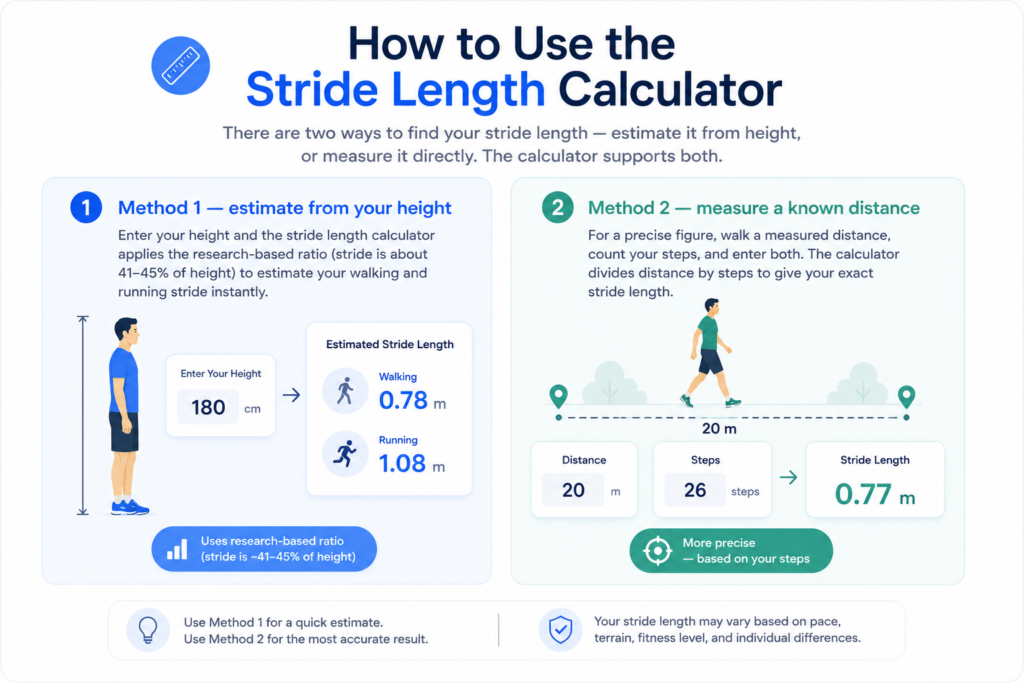
Enter your height and the stride length calculator applies the research-based ratio (stride is about 41–45% of height) to estimate your walking and running stride instantly.
For a precise figure, walk a measured distance, count your steps, and enter both. The calculator divides distance by steps to give your exact stride length.
A step length is the distance from one foot’s heel strike to the other foot’s heel strike. A stride length is two steps, from one foot’s heel strike to the next heel strike of the same foot. Stride length is therefore about double step length.
These two terms are often used interchangeably, but they measure different things — and mixing them up throws off your calculations. Getting the distinction right is the difference between an accurate result and one that is off by half. Learn More
Your step length is the distance covered by a single step, one foot moving past the other. For an average adult it is roughly 2.2 to 2.5 feet (about 67 to 76 cm).
Your stride length covers two steps, a full gait cycle, returning the same foot to the ground. It is about double your step length, typically 4.4 to 5 feet (about 134 to 152 cm) for an average adult.
The average stride length is about 1.4 to 1.6 metres (4.6 to 5.2 feet) for adults, while average step length is roughly 0.7 to 0.8 metres. Men average slightly longer than women, but height is the main driver, not gender.
The average man has a stride of about 5.0 feet and the average woman about 4.4 feet, reflecting average height differences. At the same height, the figures are nearly identical.
Running lengthens your stride considerably, a runner’s stride can be 50% longer than their walking stride, because of the longer push-off and flight phase.
Height is the strongest predictor of stride length. The charts below show estimated walking stride length and step length across common heights.
| HEIGHT | STRIDE (FT) | STRIDE (CM) |
|---|---|---|
| 5‘0" (152 cm) | 4.15 | 126 |
| 5‘4" (163 cm) | 4.43 | 135 |
| 5‘6" (168 cm) | 4.57 | 139 |
| 5‘9" (175 cm) | 4.78 | 146 |
| 6‘0" (183 cm) | 4.98 | 152 |
| 6‘2" (188 cm) | 5.12 | 156 |
| HEIGHT | STEP (IN) | STEP (CM) |
|---|---|---|
| 5‘0" (152 cm) | 24.9 | 63 |
| 5‘4" (163 cm) | 26.6 | 68 |
| 5‘6" (168 cm) | 27.4 | 70 |
| 5‘9" (175 cm) | 28.7 | 73 |
| 6‘0" (183 cm) | 29.9 | 76 |
| 6‘2" (188 cm) | 30.7 | 78 |
An estimate from height is a great start, but measuring your own stride length gives the most accurate figure. Here are three reliable methods
Mark a start point, walk 10 natural steps, and mark the end. Measure the distance and divide by 10 for step length, or by 5 for stride length.
Walk a measured distance such as 20 metres at your normal pace, count your steps, and divide the distance by the step count. This averages out variation for a reliable result.
Wet your feet and walk across a dry surface, then measure heel-to-heel between consecutive same-foot prints for stride, or opposite-foot prints for step length.
Running stride length is longer than walking because of the airborne phase between steps. A typical running stride is about 0.5 to 0.52 of your height, versus 0.41 to 0.45 for walking.
A 5’6″ runner has a stride of roughly 5.7 feet, and a 6’0″ runner about 6.2 feet. Stride also lengthens with speed, so sprinting produces a longer stride than jogging.
Your stride length is the hidden number behind every step-based measurement. It determines how many steps you take per mile, how accurately your fitness tracker estimates distance, and how your step goals translate into real-world walking. Setting your correct stride in your tracker’s profile is one of the simplest ways to improve its distance accuracy.
For runners, stride length is also a key form metric — overstriding can cause injury, while an efficient stride improves economy. Once you know your figure, our steps to miles calculator and steps per mile by height chart put it to work.
The average stride length is about 1.4 to 1.6 metres (4.6 to 5.2 feet) for adults. Average step length is roughly 0.7 to 0.8 metres. Height is the main factor, not gender.
A step length is from one foot’s heel strike to the other foot’s. A stride length covers two steps, the same foot striking twice, so stride is about double step length.
Multiply your height by about 0.43 for an estimate. A 5’6″ (66 inch) person has a stride of roughly 28 inches step length, or about 4.6 feet full stride.
Walk a measured distance like 20 metres at your normal pace, count your steps, and divide distance by steps for step length. Multiply by two for stride length.
The average step length is about 70 cm for a person of average height, ranging from roughly 63 cm at 5’0″ to 78 cm at 6’2″.
There is no single ideal, it depends on your height. A stride around 41 to 45% of your height for walking is normal. Forcing a longer stride can reduce efficiency and risk injury.
Yes. Running stride is about 50 to 52% of height versus 41 to 45% for walking, because of the airborne phase between running steps.n arm motion does not match your steps.
The average woman has a walking stride of about 4.4 feet (134 cm), reflecting average height. A taller woman’s stride approaches the male average.
Every formula is based on peer-reviewed ACSM stride research.