
Exactly how Steps Convertor calculates every result with the research and formulas in full.
We believe you should be able to see precisely how any number on this site was reached. This page documents the formulas, research sources, and assumptions behind every steps to miles, kilo meter, and calorie calculation we provide. Nothing is hidden, and nothing is guesswork, each figure traces back to peer-reviewed exercise science.
Converting steps to distance comes down to one variable: your stride length. The core formula is straightforward.
Distance (miles) = (Steps × Stride length in feet) ÷ 5,280
Since 5,280 feet make a mile, multiplying your step count by your stride length and dividing gives the distance covered. For kilometres, we convert the result using the exact factor 1 mile = 1.60934 km.
When you enter your height, we estimate stride length as a proportion of it. Research consistently places walking stride at roughly 41–45% of standing height. We use this relationship so that taller users get longer strides and shorter users get shorter ones, rather than applying a single average to everyone.
Our steps-per-mile figures are grounded in a study that physically measured how many steps people take to cover a mile at different speeds, from a slow walk to a run.
Primary source: Hoeger, W. K., Bond, L., Ransdell, L., Shimon, J. M., & Merugu, S. (2008). One-Mile Step Count at Walking and Running Speeds. ACSM’s Health & Fitness Journal, 12(1), 14–19.
This research is why our calculators distinguish between walking and running, and across different paces, the study showed that steps per mile fall substantially as speed rises, because stride length increases. A flat “2,000 steps per mile” rule ignores this; we don’t.

| PACE | STEPS/MILE (AVG) |
|---|---|
| Slow walk | ~2,500 |
| Moderate walk | ~2,200 |
| Brisk walk | ~1,900 |
| Run | ~1,400 |
Calorie burn depends heavily on body weight and intensity, so our steps to calories calculations use the MET (metabolic equivalent) system rather than a flat per-step figure.
Calories = MET × weight (kg) × time (hours)
A MET value represents the energy cost of an activity relative to rest. Each walking and running pace has an established MET value, which we combine with your body weight and the time spent moving to estimate calories burned.
Source: Ainsworth, B. E., et al. (2011). Compendium of Physical Activities: a second update of codes and MET values. Medicine & Science in Sports & Exercise, 43(8), 1575–1581.
When you don’t supply a value, we apply documented defaults: a body weight of 70 kg (155 lb) for calorie estimates, and a moderate walking pace. Entering your own weight and pace always produces a more accurate figure.
Where our tools reference weight loss, we use the widely cited figure that one pound of body fat represents roughly 3,500 calories. This is a useful planning approximation, not an exact biological constant — real weight change depends on diet, metabolism, and many other factors.
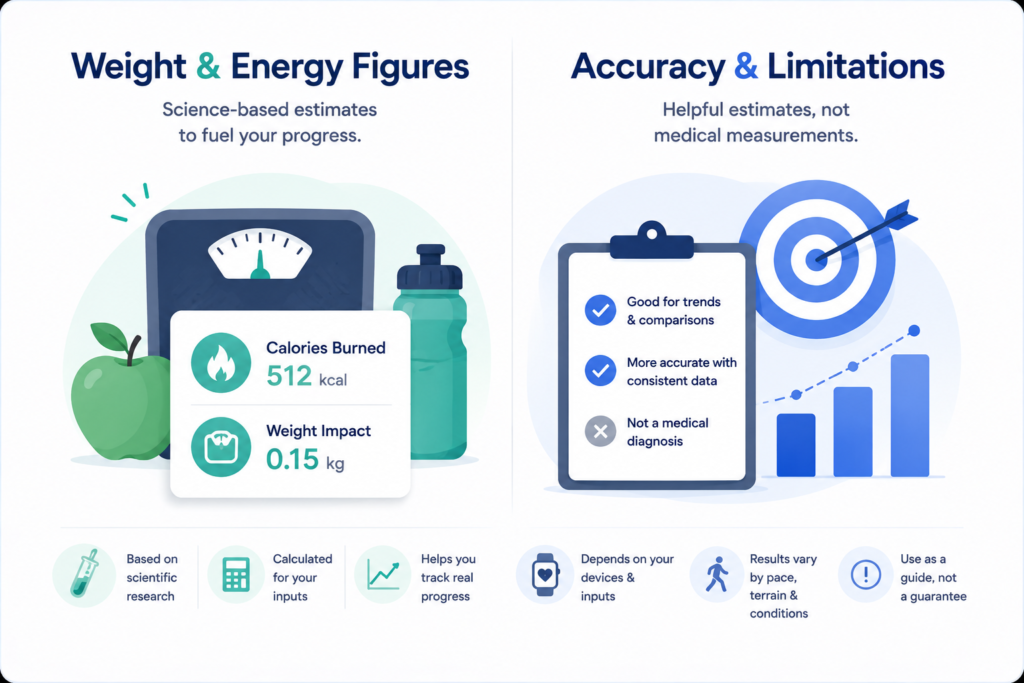
Every result on StepsConvertor is a well-grounded estimate, not a laboratory measurement. Stride length varies with terrain, footwear, fatigue, and individual gait. Calorie burn varies with fitness, body composition, and metabolism. We account for the largest variable, height, pace, and weight, but no calculator can capture every personal factor.
We review our formulas and sources periodically and update them when better research becomes available. Full references are listed below, and you can always reach us through our contact page if you spot something that should be corrected, accuracy is the whole point of this site.
Hoeger et al. (2008), ACSM’s Health & Fitness Journal 12(1):14–19 · Ainsworth et al. (2011), Compendium of Physical Activities, MSSE 43(8):1575–1581 · Paluch et al. (2021), JAMA Internal Medicine, daily step thresholds.