
Convert any step count to kilometers, miles, calories, and time instantly.
Our steps to km calculator turns any step count into your exact distance in kilometres in seconds. Type in the number from your Fitbit, Apple Watch, Garmin, or phone, and you instantly get your distance in kilometres and miles, the calories you burned, and how long the walk took. It is free, needs no sign-up, and personalises every result using your height and pace, so the answer reflects your stride, not a rough average.
| Steps | Miles | Km |
|---|
Converting your steps to kilometres takes about ten seconds and three simple inputs. There is nothing to install and no account to set up.
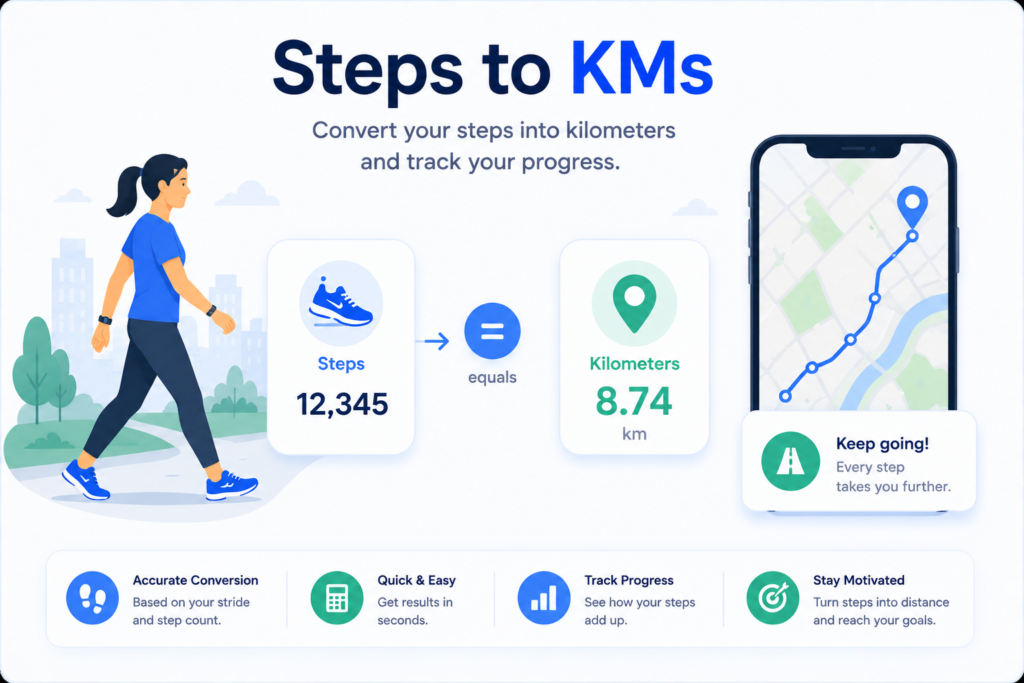
Type or paste the total number of steps from your fitness tracker, smartwatch, or pedometer app. The steps to km calculator accepts anything from a single step up to 999,999, so it works whether you are checking a short stroll or a full day on your feet.
These two inputs are optional but they make a real difference to accuracy. Your height sets your natural stride length, and your pace adjusts it further, a brisk walk covers more ground per step than a slow amble. Choose your height and select a pace from slow walk through to sprint.
Your distance appears immediately in kilometres, with the miles equivalent, calories burned, and estimated walking time shown alongside. One calculation, four answers, no extra clicks.
For most adults, one kilometre equals roughly 1,250 to 1,550 steps when walking at a moderate pace. The exact number depends on your height and stride length, because taller people take fewer, longer steps. As a quick rule of thumb, 10,000 steps is about 7 to 8 kilometres. Learn More
That range is not vague for no reason, it exists because no two people walk identically. Three factors decide how many steps fit into a kilometre: your height, your walking speed, and the surface beneath you. Understanding them is what separates a rough guess from an accurate steps to km conversion, and it is exactly what our calculator accounts for.
Stride length is roughly 41 to 45 percent of your height. Someone who is five feet tall has a walking stride of about 64 centimetres and covers a kilometre in around 1,560 steps. Someone who is six foot two has a stride closer to 84 centimetres and needs only about 1,185 steps for the same kilometre, a gap of nearly 400 steps. This is why entering your height sharpens the result so much.
The faster you move, the longer each stride becomes, so you take fewer steps to cover a kilometre. A gentle stroll might take 1,550 steps per kilometre, while a brisk six-and-a-half kilometre per hour walk drops that closer to 1,180. Running stretches your stride further still.
| PACE | SPEED | STEPS / KM |
|---|---|---|
| Slow walk | 3 km/h | ~1,550 |
| Moderate walk | 5 km/h | ~1,370 |
| Brisk walk | 6.5 km/h | ~1,180 |
| Jog | 9 km/h | ~990 |
| Run | 12 km/h | ~870 |
Use the table below to look up any step count without opening the calculator. Figures use an average adult stride at a moderate walking pace. For a personalised steps to kilometers figure that reflects your own height, use the tool at the top of the page. Check our Steps to Miles Calculator.
| STEPS | AVG KM | WOMEN 5‘4" | MEN 5‘9" |
|---|---|---|---|
| 1,000 | 0.73 | 0.69 | 0.76 |
| 3,000 | 2.19 | 2.08 | 2.29 |
| 5,000 | 3.65 | 3.46 | 3.81 |
| 7,000 | 5.12 | 4.84 | 5.33 |
| 10,000 | 7.32 | 6.92 | 7.62 |
| 15,000 | 10.97 | 10.38 | 11.43 |
| 20,000 | 14.63 | 13.84 | 15.24 |
| HEIGHT | WALKING | RUNNING |
|---|---|---|
| 5‘0" (152 cm) | 1,562 | 1,095 |
| 5‘6" (168 cm) | 1,382 | 968 |
| 5‘9" (175 cm) | 1,312 | 919 |
| 6‘2" (188 cm) | 1,185 | 829 |
10,000 steps is approximately 7.3 kilometres for an average adult walking at a moderate pace. A woman of average height covers about 6.9 km, while a man of average height covers about 7.6 km. At a brisk pace the distance rises slightly, since each stride lengthens.
The 10,000-step figure is the most searched steps to km conversion by a wide margin, largely because it remains the default daily goal on most fitness trackers. Converting it to kilometres makes the target tangible: roughly 7 km a day is a distance most people can picture as a route around their neighbourhood or a stretch of a local park.
Each figure below uses an average moderate-pace stride. Every conversion has a dedicated guide with a full breakdown by height and pace.
≈ 2.19 km Full guide on 3000 steps to Km→
≈ 10.97 km Full guide on 12000 steps to miles →
≈ 3.65 km Full guide on 10000 steps to miles →
≈ 14.63 km Full guide on 15000 steps to miles →
Most fitness trackers convert steps to distance using an accelerometer combined with the height in your profile. On flat ground at a steady pace, their accuracy usually lands within 5 to 10 percent of the true distance. It drifts more during slow movement, on stairs, or when your arms move independently of your feet.
Fitbit estimates your stride from your height and refines it with GPS during outdoor walks. If you want to check Fitbit's number, enter your step total into the steps to km calculator for an independent estimate.
Apple Health and Samsung Health both use motion sensors with optional GPS calibration. Their step count and distance figures can differ slightly because they are measured in different ways, so a second opinion from a dedicated calculator is useful.
Most of the world measures distance in kilometres, so converting your steps to km matches how you already think about a walk or run. In the UK, Europe, Australia, New Zealand, India, and most of Asia, road signs, treadmills, running tracks, and fitness apps all display kilometres. A parkrun is 5 km; a typical local loop is measured in kilometres, not miles.
Framing your daily activity in kilometers also makes it easier to benchmark against public-health guidance. When you know that your 8,000 daily steps equal roughly 5.9 km, you can compare that against distance-based goals and plan routes you can actually visualize, a far more useful number than an abstract step count for most people outside the United States.
The maths is identical; only the unit differs. If you live in a country that uses the metric system, converting steps to km will feel more natural and match your tracker’s default display. If you are in the United States or United Kingdom road network, miles may suit you better. Our calculator switches between both instantly, so you never have to pick one permanently
One kilometre is 0.62 miles, so the numbers always relate predictably: 10,000 steps is about 7.3 km or 4.5 miles. If you ever need the imperial version, our steps to miles calculator uses the same personalised stride logic.
The famous 10,000-step goal began as a 1965 marketing slogan for a Japanese pedometer, not as medical advice. More recent research published in JAMA Internal Medicine (Paluch et al., 2021) found that health benefits for most adults begin to appear around 7,000 steps a day, roughly 5 kilometres. Converting your steps to km turns that target into a distance you can plan a route around.
Your ideal daily distance also depends on age, fitness, and goals. Distance is only half the picture, though, if weight management is your aim, what those kilometers burn matters just as much as how far you walk. Once you know your daily distance here, our steps to calories calculator shows roughly how much energy you spent covering it.
10,000 steps equals roughly 7.3 km for an average adult, about 6.9 km for a woman of average height and 7.6 km for a man. The exact distance depends on your stride length, which is set mainly by height and pace.
Most adults take between 1,250 and 1,550 steps per kilometre. An average-height person walking at a moderate pace takes about 1,370. Taller people take fewer around 1,185 for someone six foot two.
Divide your step count by roughly 1,370 for a quick estimate, so 10,000 steps is about 7.3 km. For an accurate figure, use a calculator that factors in your height and pace, since stride length varies significantly between people.
5,000 steps equals about 3.65 km at a moderate walking pace, which takes most people 35 to 45 minutes of continuous walking to complete.
Yes. “Km”, “kilometers”, and “kilometres” all mean the same unit — only the spelling differs by region. The conversion is identical, and this calculator works for every spelling.
20,000 steps equals about 14.6 km at a moderate pace. Covering this in a day is a significant effort, taking most walkers around two and a half to three hours of continuous movement.
Fitbit, Apple Watch, Garmin, and Samsung Health estimate within 5 to 10 percent on flat ground at a steady pace. Accuracy drops during slow movement, stair climbing, or when arm motion does not match your steps.
A six-foot-two adult takes around 1,185 steps per kilometre walking, compared with about 1,560 for a five-foot adult. Height drives stride length, which is why the calculator asks for it.
Every formula is based on peer-reviewed ACSM stride research.