
Convert your steps into calories burned, personalized by weight, pace, and height.
This steps to calories calculator turns any step count into an accurate estimate of the calories you burned. Enter your steps, add your weight, and get your result in seconds, because unlike distance, calorie burn depends heavily on how much you weigh. The tool is free, needs no sign-up, and personalizes every figure by weight, pace, and height so the number reflects your body, not a generic average.
Estimating the calories your steps burned takes about ten seconds. There is nothing to download and no account required.
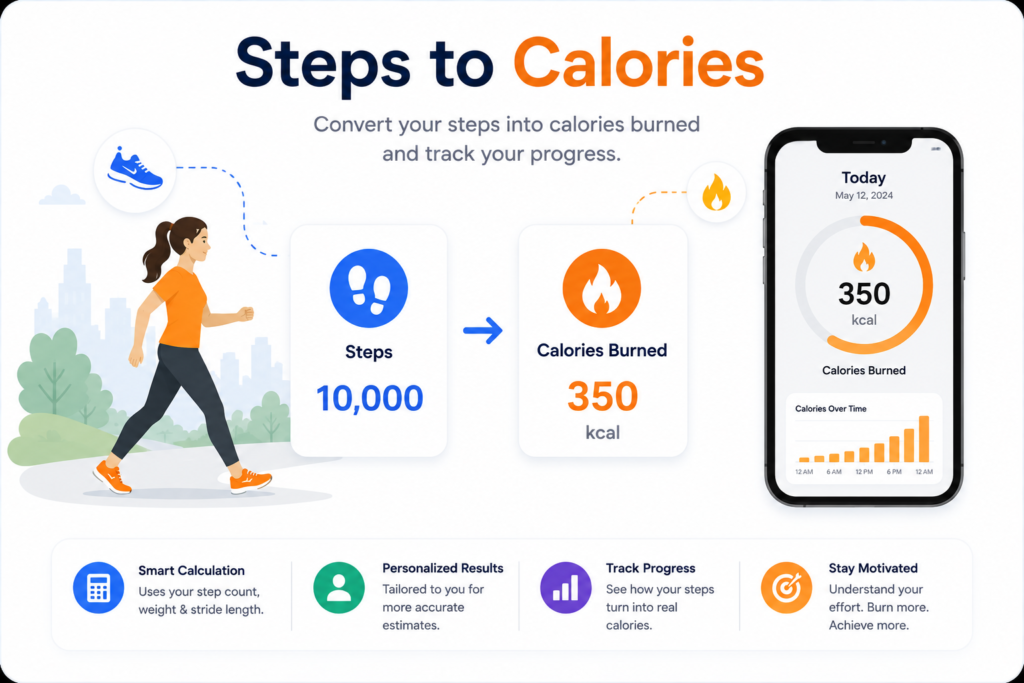
Type or paste the total number of steps from your fitness tracker, smartwatch, or phone. Any value from a single step to 999,999 works.
Weight is the most important input here — a heavier body burns more energy covering the same steps. Height fine-tunes your stride, and pace adjusts intensity. Together they make the steps to calories estimate genuinely personal.
Your estimated calories appear instantly, alongside the distance covered and walking time, so you see the full picture of your activity at once.
On average, walking burns about 0.04 to 0.05 calories per step, so 1,000 steps burns roughly 40 to 50 calories for most adults. The exact figure depends mainly on your body weight, plus your walking pace and stride. As a rule of thumb, 10,000 steps burns around 400 to 500 calories. Learn More
That range is wide because calorie burn is far more individual than distance. Two people can walk the same 10,000 steps and burn very different amounts. Three things drive the difference, and a good steps to calories estimate accounts for all of them.
Moving a heavier body requires more energy, so weight has the largest effect on calorie burn. A 250-pound person burns nearly double the calories of a 125-pound person over the same step count. This is why our calculator asks for weight first, without it, any calorie figure is little more than a guess.
Faster movement raises intensity and burns more calories per minute. A brisk walk burns noticeably more than a slow stroll over the same distance, and a jog or run more still. Pace is the second input that separates a real estimate from a flat average.
The tool uses MET values from the Compendium of Physical Activities: calories = MET × weight in kg × hours. Each pace has its own MET, grounding the estimate in research.
| PACE | SPEED | STEPS / KM |
|---|---|---|
| Slow walk | 3 km/h | ~1,550 |
| Moderate walk | 5 km/h | ~1,370 |
| Brisk walk | 6.5 km/h | ~1,180 |
| Jog | 9 km/h | ~990 |
| Run | 12 km/h | ~870 |
Estimate without the calculator. Because weight matters most, this chart breaks results down by body weight. For a personalised figure the steps to calories calculator above adds pace and height. Check our Steps to Miles Calculator.
| STEPS | 125 LB | 155 LB | 185 LB | 215 LB |
|---|---|---|---|---|
| 2,000 | 60 | 75 | 89 | 104 |
| 5,000 | 150 | 186 | 222 | 259 |
| 10,000 | 300 | 372 | 444 | 518 |
| 15,000 | 450 | 558 | 666 | 777 |
| 20,000 | 600 | 744 | 888 | 1,036 |
An average adult burns about one calorie every 20 steps, so it takes roughly 2,000 steps to burn 100 calories, 10,000 steps to burn 500 calories, and 20,000 steps to burn 1,000 calories. Heavier people reach these targets in fewer steps.
Working backwards from a calorie goal is one of the most useful ways to plan a walk. The table shows steps needed for every common target at 155 lb.
| GOAL | STEPS | DISTANCE |
|---|---|---|
| 100 cal | ~2,700 | 1.2 mi |
| 150 cal | ~4,000 | 1.8 mi |
| 200 cal | ~5,400 | 2.4 mi |
| 250 cal | ~6,700 | 3.0 mi |
| 300 cal | ~8,100 | 3.7 mi |
| 400 cal | ~10,750 | 4.9 mi |
| 500 cal | ~13,400 | 6.1 mi |
| 600 cal | ~16,100 | 7.3 mi |
| 700 cal | ~18,800 | 8.5 mi |
| 800 cal | ~21,500 | 9.8 mi |
| 1,000 cal | ~26,900 | 12.2 mi |
| 1,500 cal | ~40,300 | 18.3 mi |
| 2,000 cal | ~53,800 | 24.4 mi |
| 3,500 cal · 1 lb fat | ~94,000 | 42.7 mi |
At 155 lb, moderate pace. Use the calculator for your weight.
| STEPS | CAL | STEPS | CAL |
|---|---|---|---|
| 3,000 | ~112 | 11,000 | ~409 |
| 4,000 | ~149 | 12,000 | ~446 |
| 5,000 | ~186 | 13,000 | ~483 |
| 6,000 | ~223 | 14,000 | ~521 |
| 7,000 | ~260 | 15,000 | ~558 |
| 8,000 | ~298 | 16,000 | ~595 |
| 9,000 | ~335 | 18,000 | ~669 |
| 10,000 | ~372 | 20,000 | ~744 |
Trackers estimate from steps, profile, and heart rate — useful for comparison but often off 20–30%, usually high. A weight-based steps to calories estimate gives a second opinion.
Accuracy improves when weight and height are set correctly.
Total includes resting burn; step estimates count only active calories, so they read lower than your watch's total.
One pound of fat is roughly 3,500 calories — the same figure in the burn table above. At about 372 cal per 10,000-step day, walking off a pound through steps alone takes roughly 94,000 steps, which is why diet matters alongside activity. Converting steps to calories shows exactly how walking feeds your deficit.
Pair this with the steps to miles calculator, or set a target with steps for weight loss.
Roughly 300–500 calories for most adults, about 372 for a 155-lb person at moderate pace. Weight is the biggest factor.
About one calorie every 20 steps. Heavier people burn it in fewer; lighter people need slightly more.
Roughly 10,000–13,000 steps at average weight. Faster pace or higher body weight lowers the number needed.
About 94,000 steps for a 155-lb adult, roughly 43 miles. Walking supports weight loss but works best combined with diet.
It gives a solid estimate from weight, pace, and MET values. No step method is exact, but factoring weight beats a flat average.
Yes, a heavier body needs more energy, so a 200-lb person burns more than a 130-lb person over the same steps.
Yes. A brisk walk burns more per minute than a slow one; jogging more still. Pace raises intensity.
About 180–270 depending on weight, roughly 223 for a 155-lb adult at moderate pac
Every formula is based on peer-reviewed ACSM stride research.